
If you own your home and have been paying down your mortgage for a few years, you might have built up something called home equity. Equity is simply the difference between what your home is worth today and what you still owe on your mortgage. For example, if your house could sell for 300,000 dollars and you owe 200,000 on your loan, you have 100,000 dollars in equity. That equity is a financial resource you can tap into, and one of the most common reasons homeowners do that is to fund home improvements.
A Home Equity Line of Credit, commonly called a HELOC, is one way to use your equity for renovations. Think of a HELOC like a credit card that is secured by your house. You get approved for a certain maximum amount, say 50,000 dollars, but you do not have to borrow all of it at once. Instead, you can draw money as you need it during a set time period, which is usually ten years. This makes HELOCs very popular for home improvement projects because renovations often happen in stages. You might need money for the contractor’s deposit, then later for materials, then for finishing work. With a HELOC you only borrow what you need when you need it, and you only pay interest on the amount you have actually taken out, not on the whole line.
During the draw period, which typically lasts five to ten years, you are usually only required to pay the interest each month. That keeps your monthly payments low while the work is going on. After the draw period ends, the line closes and you enter the repayment period. For the next ten or fifteen years, you have to pay back both the principal and the interest in fixed monthly installments. So you need to plan ahead for that higher payment down the road.
Why would a homeowner choose a HELOC over other options like a cash-out refinance? The main reason is flexibility. With a cash-out refinance you get a lump sum all at once, and you start paying interest on the full amount right away. If your renovation is small or you are not sure exactly how much you will need, a HELOC lets you take money in pieces. It also usually has lower upfront costs than a refinance. Many HELOCs come with no closing costs or very low fees, though you might still pay an annual fee.
Another advantage is that the interest on a HELOC is often tax deductible if you use the money to buy, build, or substantially improve your home. That can lower your effective cost. But you should always check with a tax professional because rules change and not everyone qualifies.
There are some downsides to be aware of. Because a HELOC is a second mortgage, it is secured by your home. That means if you fall behind on payments, the lender can foreclose on your house. It is a serious commitment. The interest rate on a HELOC is usually variable, not fixed. That means your monthly payment can go up if interest rates rise. During the draw period you are only paying interest, so your balance does not shrink. That can be dangerous if you get used to low payments and then the repayment period hits with much larger bills.
When you apply for a HELOC, the lender will look at your credit score, your income, and how much equity you have. Most lenders want you to keep your total debt, including your first mortgage and the HELOC, at no more than 80 to 90 percent of your home’s value. So if your house is worth 300,000, you can generally borrow up to 240,000 to 270,000 total across both loans. That means the size of your HELOC depends on what you already owe.
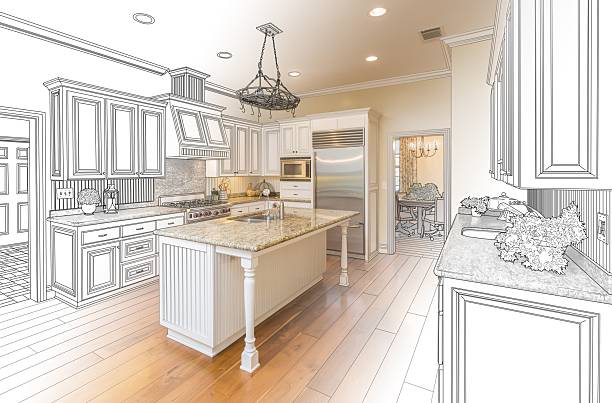
Using a HELOC for home improvements makes financial sense when the improvements add real value to your home. A new kitchen, an extra bathroom, or a finished basement can increase your home’s resale price. But you should be careful not to over-improve for your neighborhood. If you spend 50,000 on a luxury remodel but houses around you are only worth 250,000, you may not get your money back when you sell.
A practical step for any homeowner is to get several estimates for your renovation before you apply for a HELOC. That way you know roughly how much you need. Then shop around for HELOC rates from different banks and credit unions. Compare not just the interest rate but also any fees, the length of the draw period, and what happens if you pay off the line early. Some lenders charge a penalty if you close the HELOC within a few years.
Finally, remember that a HELOC is not free money. It is a loan that must be repaid. But when used wisely for home improvements that increase comfort, efficiency, or value, it can be a smart tool. Just make sure you have a solid plan for when the draw period ends and the real payments begin. With careful budgeting, a HELOC can turn the equity in your home into the improvements you have been dreaming about.